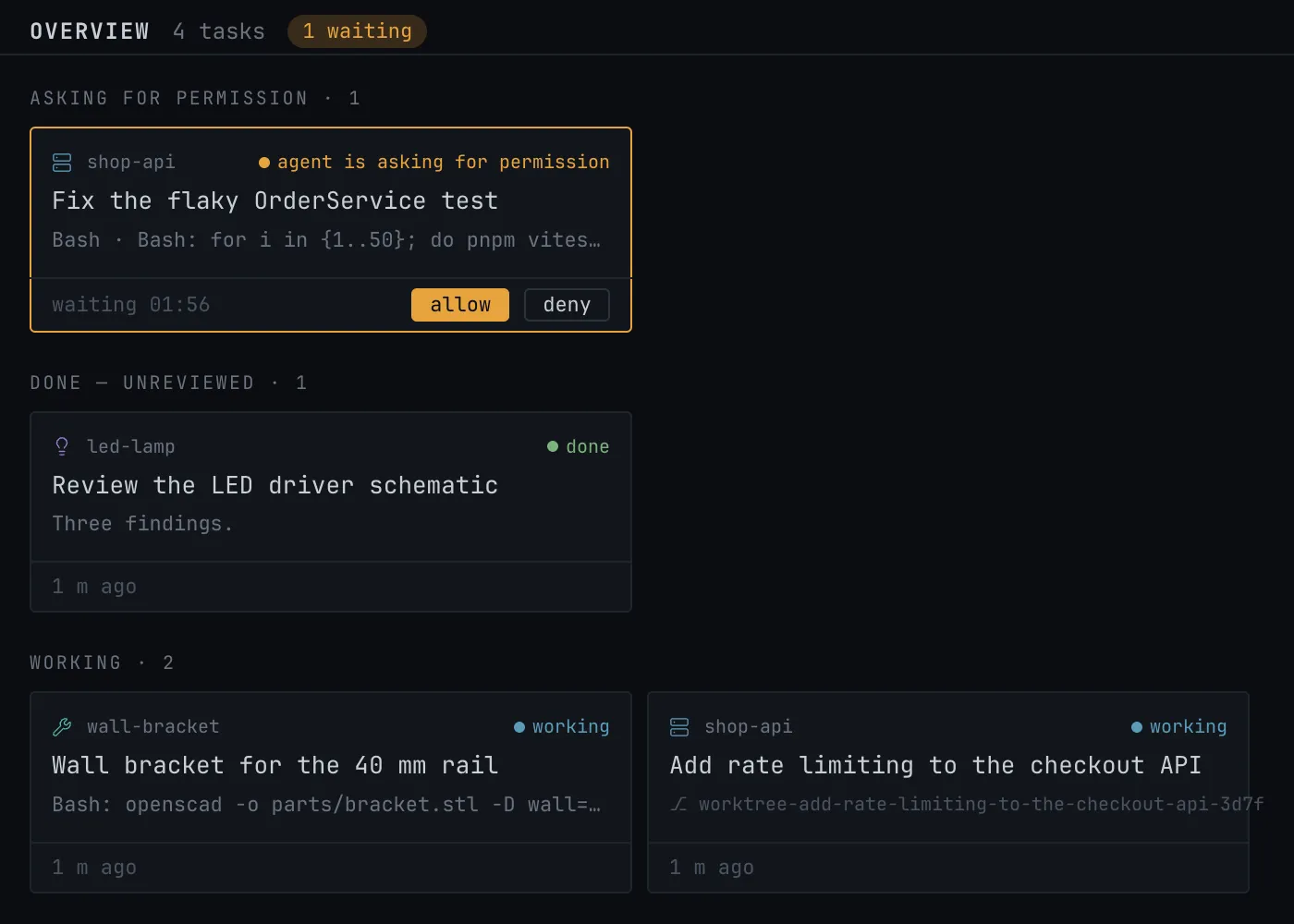
Rules start work. The Steward plans it. The Inbox waits for your go.
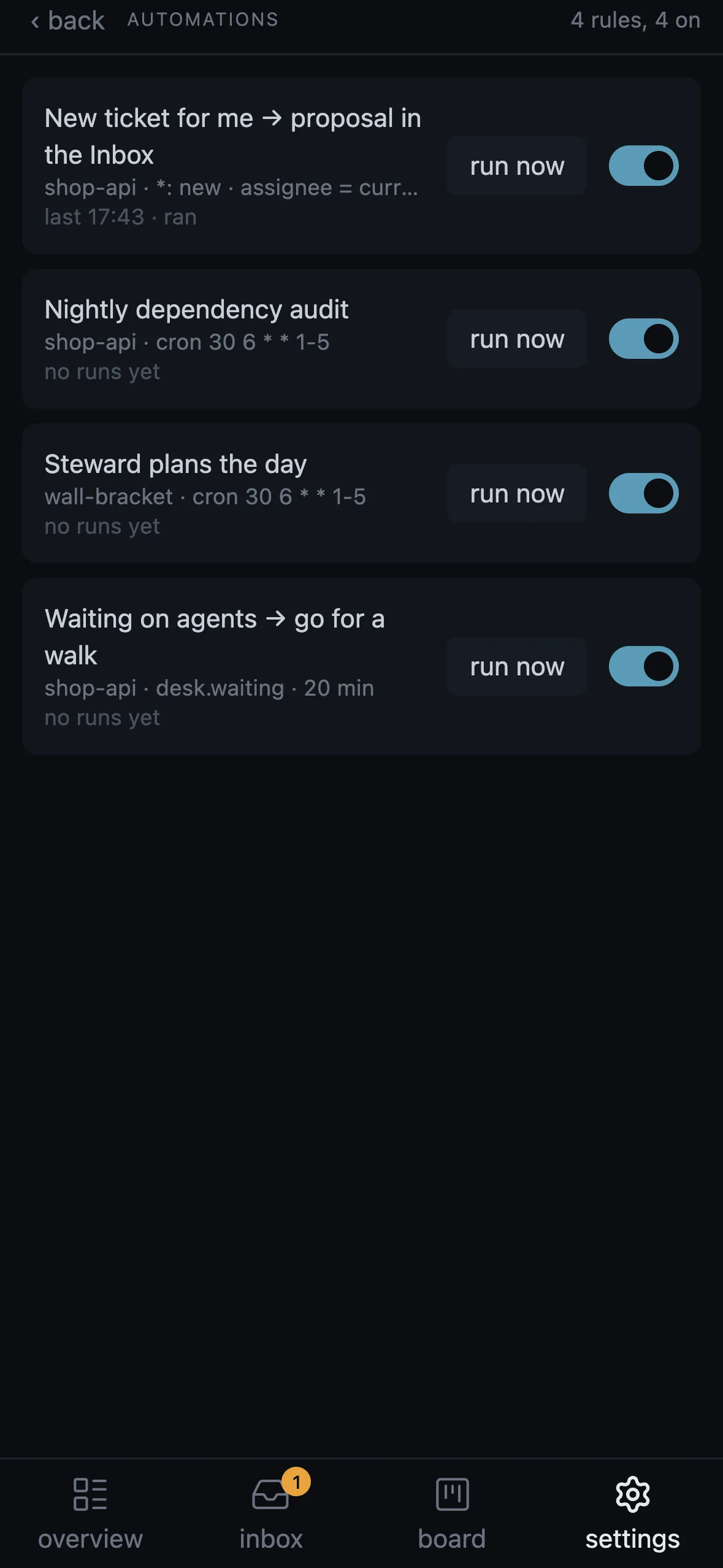
A Robion automation is a trigger plus fixed actions, run by the server with no model in the path: zero tokens until a task actually starts. Agents write the rules, you switch them on, and everything that needs a decision lands in the Inbox — on the desktop and on the phone.
Five triggers
issue.created and issue.updated: a ticket newly matching the rule’s query, or a matching ticket that changed — from Jira (JQL), GitLab or GitHub (issues and pull requests). Trackers are polled; the first poll only takes note of what exists, so an old backlog never floods you. cron.tick: five cron fields in local time.
Two triggers are about you rather than the outside world: desk.waiting fires when every agent has been running for N minutes and none needs you; desk.sitting after N minutes at the desk without a break. They are meant for pushes about you — a walk, water — never for work.
Six actions
task.create starts a Claude Code task with a prompt, in its own worktree by default. push sends to the phone. pane.send types text into a running agent. run presses a button of the project’s control panel and takes the command’s exit code as its result. inbox.propose runs nothing until you accept. steward asks for an extra plan. Actions run in order and stop at the first failure.
Agents write the rules, you switch them on
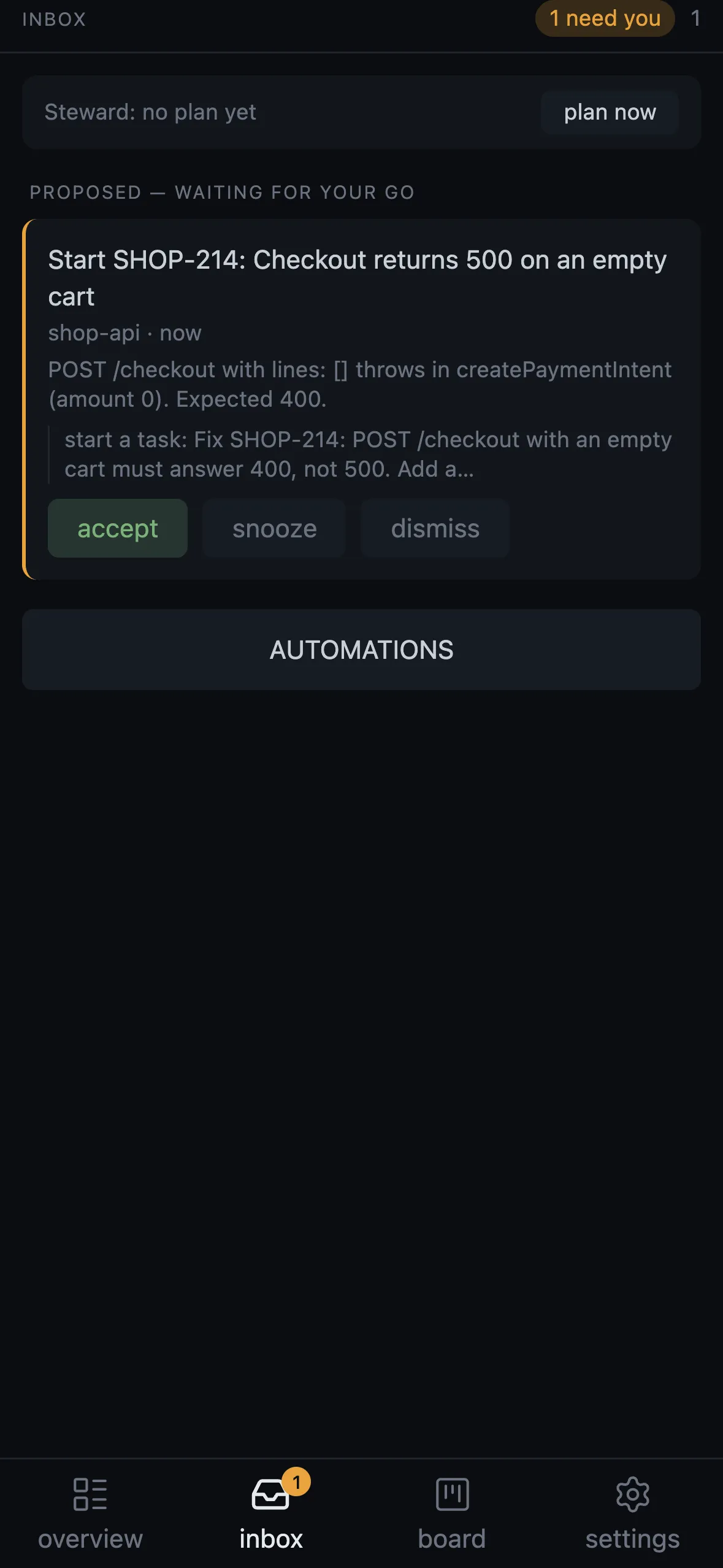
Tell an agent “when a ticket is assigned to me, start a task” and it writes the rule (set_automation, or /robion:automate). It can test it against a recent real event first, as a dry run with no side effects. A new rule is stored switched off and appears in the Inbox as a proposal; an agent never claims a rule is active.
Starter rules cover the common cases with one tick: a new ticket for you becomes a proposal, an urgent one starts a task at once with a push, and two rhythm rules remind you to leave the desk.
The Inbox: decisions, not noise
What waits for your word sits on top: rules agents proposed, proposals from rules or the Steward. Finished, started, blocked and failed runs fold under “for information”. Accept runs the prepared actions; edit the brief first if you like; snooze hides an item until the next working day; dismiss asks why with one-tap chips — already done, not now, not needed, wrong premise — and the Steward reads the answer tomorrow.
Limits keep it quiet: tasks per day, quiet hours, a throttle per rule, and an expiry for unanswered proposals. A blocked run waits in the Inbox instead of running anyway.
The Steward
The Steward is a headless Claude Code run the server starts with a briefing it composed: every project with its open tasks, tickets assigned to you, the open Inbox, the automation runs since the last plan, your board, the feedback you gave, the previous plan and its own memory. It proposes a handful of well-briefed tasks into the Inbox and never does the work itself.
Anything risky is marked “needs you”: a release or publish, a push to a shared branch, a destructive command, money, people, secrets — a fixed floor whatever the model decided. At autonomy 1 nothing starts until you accept; at autonomy 2 it starts the safe ones itself. With supervision on it reads a finished task and either sends one follow-up or hands it to you. It has no shell, no git and no other MCP servers; standing instructions live in STEWARD.md.
The board
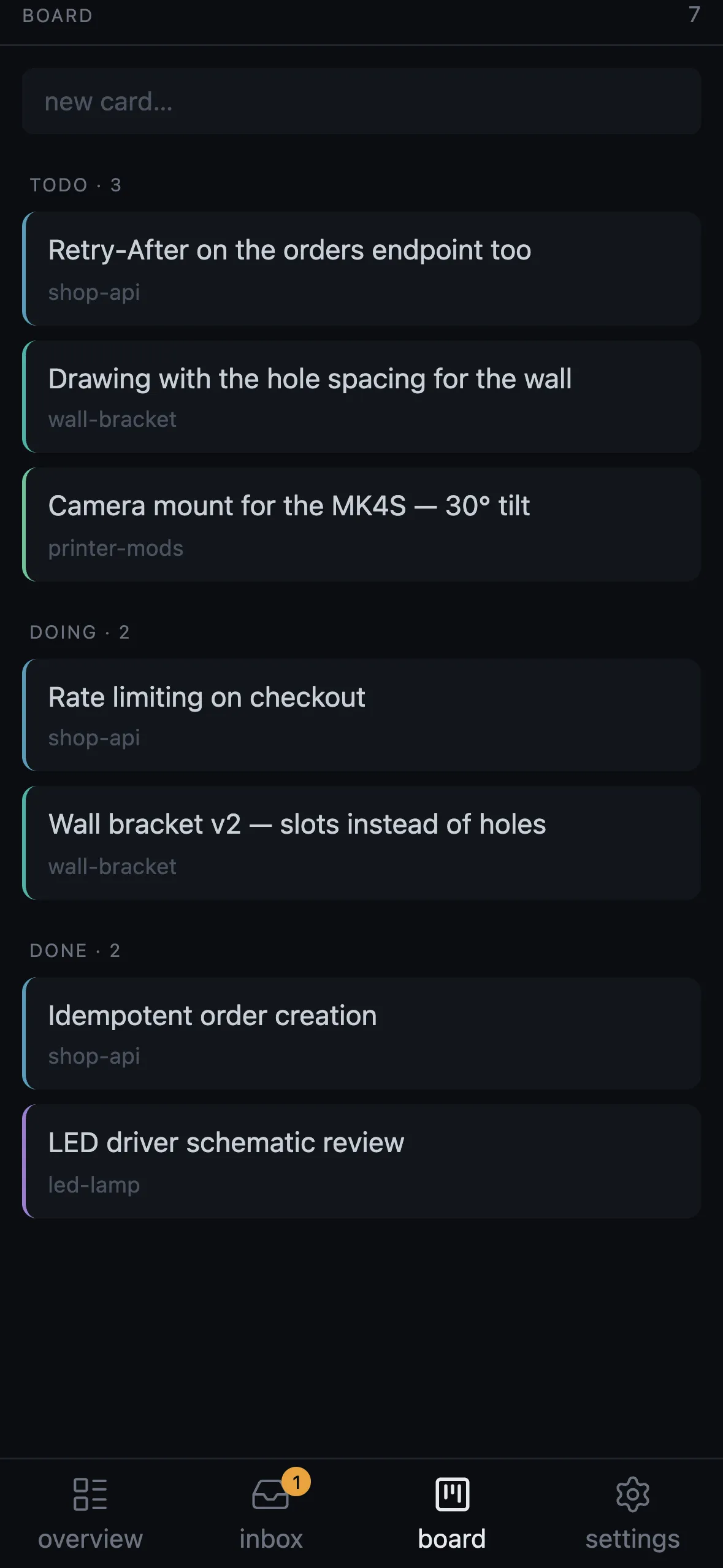
Todo, doing, done. Agents add cards when you say “remember to…”; a card starts a task and follows it to doing. The order in a column is the priority, and the Steward plans from the top of todo — a card outranks any ticket.
Questions
- Does an automation call a model?
- No. Rules run in the server without a model. Only task.create starts a Claude Code session, and the Steward is a Claude Code run you switch on yourself.
- Do rules run when the window is closed?
- Yes: closing the window hides Robion into the Dock and the server keeps running. Quitting stops it, and a sleeping Mac runs nothing; a Linux server runs around the clock.
- Which trackers?
- Jira, GitLab and GitHub, one connection each shared by every project. Tokens live in the keychain and Robion never writes to a tracker.
- How do I keep it from flooding me?
- Tasks per day, quiet hours, a throttle per rule and proposals per Steward run. Blocked runs wait in the Inbox; unanswered proposals expire.
- Can the Steward do work itself?
- No. It proposes tasks with a brief; at autonomy 2 it starts the ones it marked safe, never one under the risk floor. It has no shell and no git.
In the manual
- Automations & Steward — The board, the Inbox, automation rules and their history, the Steward with its schedule, standing instructions and memory.
- Settings — Global and per-project settings: Jira, GitLab and GitHub, servers and remote access, hooks, packs, privacy and telemetry, updates, where data lives on disk.
Try it on your own projects.
free · signed & notarized · updates itself